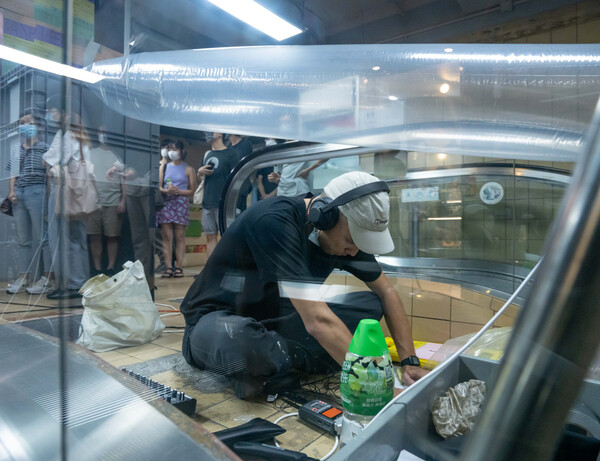
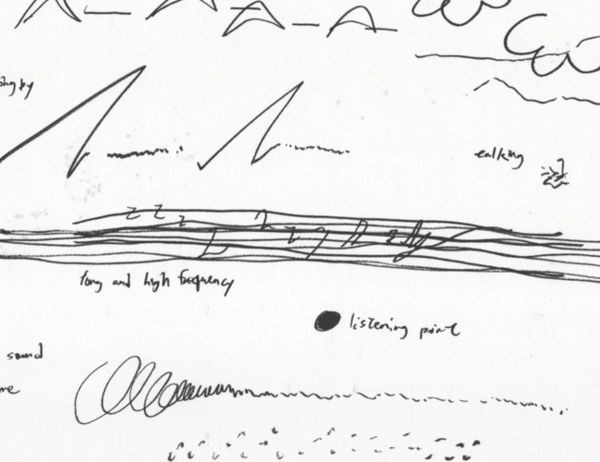
Shortlists offer thematic selections from AAA Collections, including overviews and annotations by invited contributors. The following shortlist by Jaren Ng looks at publications that trace the development of sound practices in Hong Kong and beyond.
Sound unfolds over time and transforms space into a site of encounter.1 Invisible, immersive, and ephemeral, it resists the conventions through which the visual arts are typically experienced. Within museums and galleries, sound—or “silence”—often shapes how artworks are perceived and understood. Practices centred on sound further extend this condition: they can reconfigure spatial experience, shape bodily movement, and reveal social realities that often escape ocularcentric modes of attention. Since the 2000s, these practices have increasingly been theorised and exhibited under the concept of “sound art,” giving rise to a distinct field of artistic production and critical discourse. This expanded presence, however, continues to prompt an enduring question: what is sound art?
This shortlist begins with a concise overview of the historical context of sound art. Then, it turns to Hong Kong as a case study, drawing on AAA Collections alongside materials from other institutions and organisations to trace the development of sound practices in the city. It concludes with annotations of a range of sound collections—references, artist monographs, exhibition catalogues, periodicals, zines, and CDs—from Hong Kong and beyond.
Framing Sound Art
Sound art is an interdisciplinary umbrella term encompassing a wide range of practices, including sound sculptures, sound installations, soundwalks, field recording projects, sound poetry, radio works, noise practices, and performative events. The term itself remains unstable. It is less the marker of a unified movement than a retrospective label applied to varied artistic experiments. As Alan Licht notes, sound art is “an art movement that is not tied to a specific time period, geographic location or group of artists, and was not named until decades after its earliest works were produced.”2 Any attempt to fix its meaning is elusive, for the field itself thrives precisely on crossing the boundaries between contemporary art, music, and technology, and artists often bring their own interpretations to its meaning.3
Since the 1970s, the term “sound art” has been used within Western art institutions,4 as curators, theorists, and researchers have articulated various frameworks for understanding the concept. Tate Modern defines it as “art which uses sound both as its medium (what it is made out of) and as its subject (what it is about).”5 Barbara London, curator of a small exhibition Sound Art at MoMA in 1979—one the earliest exhibitions that used sound art in its title—observed that “‘sound art’ pieces are more closely allied to art than to music, and are usually presented in the museum, gallery, or alternative space.”6
In the glossary of Audio Culture: Readings in Modern Music [REF.WAD4], Christoph Cox and Daniel Warner describe sound art as a “general term for works of art that are centred on sound and are often produced for gallery or museum installation.” In another glossary from Listening through the Noise: The Aesthetics of Experimental Electronic Music [REF.DEJ6], Joanna Demers defines it as “a medium that uses sound either by itself or in combination with visual or other stimuli. Most definitions insist that sound art must be site-specific, meaning that it must in some way interact with the space in which it is heard.”
A different approach centres on the act of listening. Through his project the Museum of Portable Sound, John Kannenberg defines sound art as “art of any form that critically explores the cultural, political, scientific, and/or conceptual situations surrounding the act of listening.”7 Similarly, for the Chinese musician and critic Yan Jun, “Sound art is part of the contemporary art system, which is dominated by the visual arts…In a narrower sense, sound art refers to the art of listening—that is, the observation and appreciation of one’s environment.”8 Here, sound art functions as a mode of inquiry: asking what it means to listen and to be situated within the sonic world.
The foregoing perspectives are by no means a comprehensive survey of sound art, but they are sufficient to show that the term resists a single, fixed definition. It spans diverse mediums and disciplines, situated within different institutional and cultural contexts to reimagine sound and listening. What often connects these practices is not a common form or style, but a shared curiosity about how sound can reshape our perception and sociocultural experience, thereby foregrounding the criticality of sound practices.
Contextualising Sound Art
Readers may have noticed that the definitions of sound art cited thus far largely derive from Western European and North American contexts. Undeniably, “sound art” is a concept formed under specific historical and cultural contexts within Western art systems. When tracing its genealogies, writers occasionally refer to figures such as Futurist painter Luigi Russolo and conceptual artist Marcel Duchamp, situating sound art within broader narratives of Western art history. Another important lineage emerges from experimental music, exemplified by John Cage, whose work radically challenged the conventions of Western classical music, alongside pioneering electronic music practices such as Pierre Schaeffer’s musique concrète and Karlheinz Stockhausen’s elektronische Musik.
The prominence of Western genealogies does not suggest an absence of sound practices elsewhere. Rather, it only reflects the fact that sound art, as a meta-category, was named, theorised, and institutionalised within Western art institutions. Within this institutional context, a key issue is how sound practices that cross pre-existing genres of music and art are classified and articulated within Western art discourses. As the concept of “sound art” is adapted or translated into other regions—such as Hong Kong—its interpretations are inevitably shaped by local cultural contexts and institutional infrastructures.
Just as Western artists have held differing views on the meaning of “sound art,” the term is likewise contested in other regions. Writing on sound-based practices in China, Yan Jun deliberately avoids “sound art,” instead using “sound practices” (聲音實踐) to sidestep its conceptual tensions.9 This terminological choice reflects a gap between frameworks shaped by Western art institutions and the cultural and historical conditions of sound-making in other contexts.
Tracing Sound Practices in Hong Kong Art Ecology
Looking back to Hong Kong, how have sound practices developed within institutional and cultural contexts? This section does not seek to essentialise what “sound art” is. Instead, it adopts “sound practices” as an inclusive term to trace how artworks and events centred on sound have interacted with the city’s art ecology. The following historical overview attempts to outline several key threads that have informed their development.
Sound in Video and New Media
From the perspective of exhibition history, sound’s early presence in Hong Kong can be traced to 1999, when 1a space at the Oil Street Artist Village presented Video Ensemble, curated by May Fung, one of the founders of Videotage. The exhibition invited six video artists—Mark Chan, Olive Leung, Makin Fung, Ip Yuk-yiu, Ng Tsz-kwan, and Ellen Pau—to work with four television monitors each. Visitors could adjust the volume on all twenty-four channels, effectively composing their own sound pieces.
Similarly, the Microwave International New Media Arts Festival presented works in which sound played a primary role. In 2002, Linz-based collective Time’s Up, the artist-in-residence of the festival [EX.HGK.MIMAF.2002], presented Sonic Pong, an interactive installation that explored sound and bodily movement. In 2004, the festival [EX.HGK.MIMAF.2004] showed Christopher Lau and Samson Young’s installation piece Ritual Machine—one of Young’s earliest works conceived outside a traditional concert-hall setting. In the early phase, sound was often explored through the video medium and new media frameworks, highlighting interactive and participatory modes of engagement.

Curating Sound in Art Spaces
By the mid-2000s, sound began to occupy a curatorial role in Hong Kong’s art spaces. Sound was increasingly treated as a primary concern—one that demanded new aesthetic approaches, spatial configurations, and modes of audience engagement.
In November 2005, Habitus—a design and exhibition space at Western Market—collaborated with Videotage to present a real-time performance by Cédric Maridet and Norwegian artist HC Gilje, signalling an emerging interest in sound as a performative and event-based practice.10
This curatorial shift was reinforced in 2006 through both publication and exhibition platforms. Para Site’s magazine, PS: Visual Arts and Culture (no. 27) [PER.PS], devoted a special issue to sound art, with Yeung Yang as feature editor. It brought together diverse perspectives on sound, including an interview with May Fung reflecting on her experience with Video Ensemble. In June of the same year, White Noise Records and Para Site co-organised the SAND Music Festival, which brought experimental music directly into the gallery context, featuring Cédric Maridet, Dickson Dee (founder of the label Noise Asia), Song-Ming Ang, and Zen Lu.11 In November 2006, Maridet’s site-specific sound installation I/O Flows at the Hong Kong Visual Arts Centre engaged the building’s air-conditioning system, exploring sound’s capacity to shape architectural space.
By the late 2000s, sustained commitments from galleries and arts organisations had begun to emerge. From 2007 onwards, Osage Gallery developed several sound-focused projects that emphasised immersive experience and audience interaction. These include Siren: New Media Art (2007), featuring video and sound installation by Christopher Lau and Samson Young alongside other multimedia works; Crosscurrents: Ambient Art (2008) [MON.NGK], which included Kingsley Ng’s installation Musical Wheel, inspired by the gallery’s location in Kwun Tong; and (last) intervention (2009), which presented new works by Ng and Young treating the rapidly changing Kwun Tong as a site of social intervention and creative meditation. As part of the programme, Young led Urban Palimpsest: a twilight sound-walk, a tour in Kwun Tong in which participants listened to modified environment sounds and electronic compositions via portable devices.
During the same period, Videotage continued to curate projects that examined sound’s relationship to social space while engaging experimental music lineages. These include McSoundscape: Spatial Identity of McDonald’s in Hong Kong (2009); Sound Friction N°2—The Zen Ensemble (co-organised with Re-Records, 2010), a performance examining the composition and performance of silence; and Soundtracking #John Cage 4’33’’ (co-curated by Ellen Pau and Steve Hui), presented as part of the Wikitopia Festival (2012).
In 2009, Para Site’s engagement with sound practices culminated in HK Sound Station, curated by Álvaro Rodriguez Fominaya. The exhibition installed one CD player per artist, exploring the “sculptural possibilities of sound.”12 Technologies of sound reproduction became central to the display, further consolidating sound as a distinct curatorial approach.
Taken together, these initiatives suggest that by the late 2000s sound practices had emerged as a curatorial approach in their own right—one that connected experimental music, architectural space, bodily sensation, urban experience, and forms of social engagement.

The Emergence of Sound Organisations
Two major organisations dedicated to sound practices were founded in Hong Kong between 2007 and 2008. In 2007, Yeung Yang—who had joined the Habitus collective and edited PS: Visual Arts and Culture—curated in midair: sound works hong kong 2007 [EX.HGK.INM2], assembling multimedia artists, composers, sound designers, and sound engineers across multiple venues, including Habitus, Videotage, Hong Kong Academy for Performing Arts, Hong Kong Arts Centre, Kapok in Tin Hau, and Red House in Cheung Chau.13 The exhibition emphasised the act of listening without burdening itself with establishing a category of “sound art,” and included mapped sound-walk routes, activating the city as a site of sonic experience.
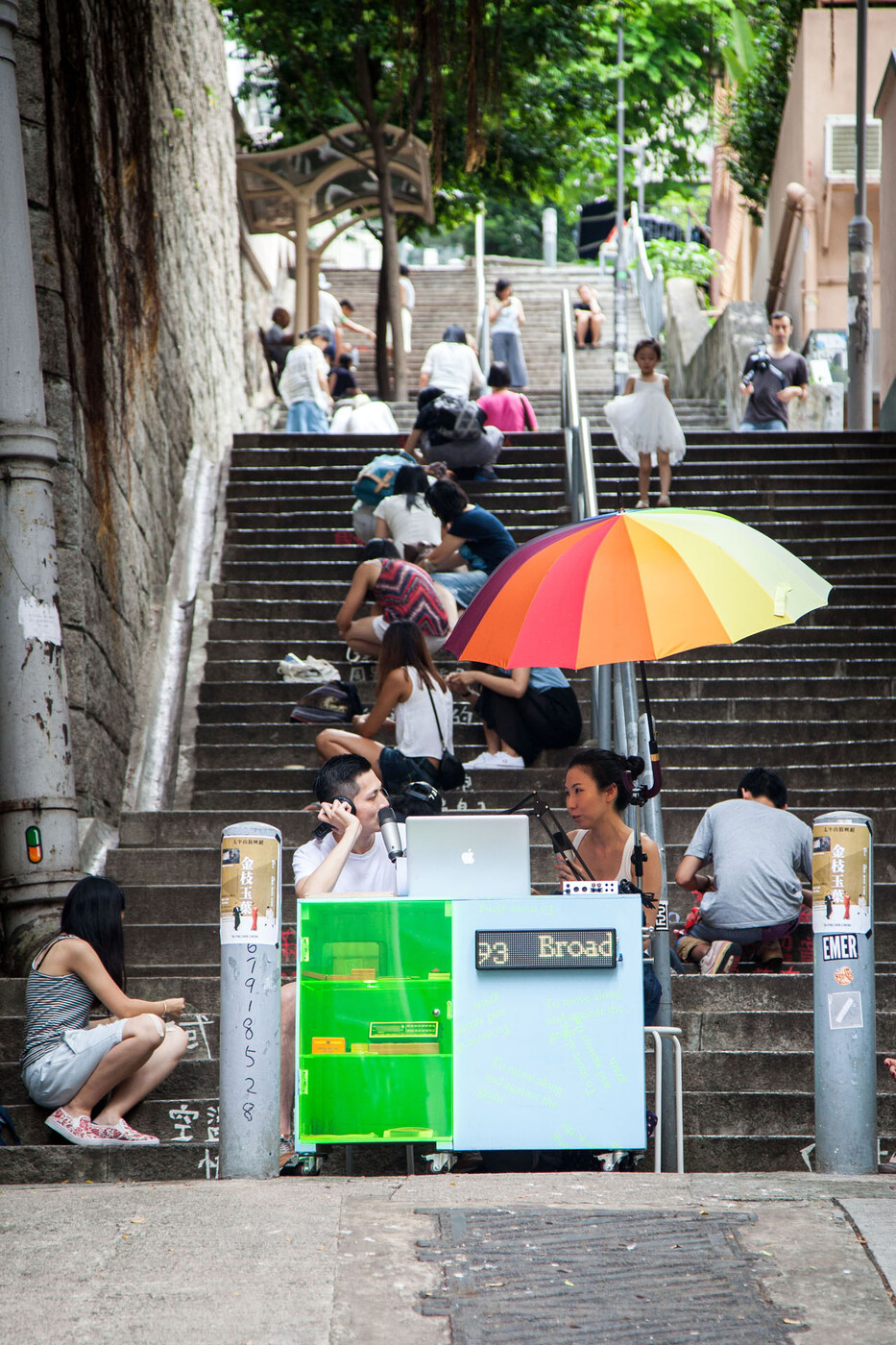
The following year, Yeung founded the non-profit soundpocket, which has since played a pivotal role in promoting sound cultures and supporting emerging local practitioners.14 Its vision positions sound as existing in “diverse and dynamic relations with many different art forms (visual art, installation art, music, theatre, dance, etc.), and with a variety of cultural contexts that give meanings to our lives.”15 Key initiatives include five editions of the Around sound art festival [EXS.HGK.ARO.2009] (2009, 2010, 2013–15), which featured performances, exhibitions, talks, and sound-walks across multiple venues. The organisation also runs an Artist Support Programme;16 the online platform The Library by soundpocket; and a series of publications, including Pocket 1: Around [REF.YAY8], a collection of ear-witness accounts of the first Around festival. In recent years, soundpocket has participated in The Listening Biennial (2023, 2025) as a partner organisation, hosting workshops and artist-sharing sessions.
Also in 2007, Samson Young founded Contemporary Musiking Hong Kong (CMHK), an organisation dedicated to sound art and experimental music that was initially established to facilitate funding applications and venue hires. A turning point came in 2011, when Young performed at Taiwan’s Lacking Sound Festival—then running monthly programmes and publishing documentation of performances online17—which inspired CMHK to launch the recurring concert series Sonic Anchor in 2012 at the McAulay Studio, Hong Kong Arts Centre.18 The inaugural concert featured Evidence (Stephan Moore and Scott Smallwood) and visual artist Jonathan Lee Marcus, who improvised with electric fans to generate shifting sounds.19 By 2025, Sonic Anchor had presented forty-eight concerts.20
In 2018, CMHK co-presented Sound Forms, Hong Kong’s first multichannel sound festival, with the Hong Kong Arts Centre. The festival has been presented seven times through 2024, with editions from 2020 onward realised in collaboration with Tai Kwun Contemporary. Other projects include the Unheard Sound and Music Festival (co-organised with Eaton HK and dtby since 2022), the artist exchange series Sonic Transmission, and the summer camp Push the ENVELOPE Sound Art Initiative. More recently, CMHK organised the Pluck to Sound festival (2025–26). Describing itself as “an incubator for cross-disciplinary practices in music, sound, and technology,”21 CMHK positions sound as a point of departure for connecting diverse media and disciplines.
Rather than defining sound art as a bounded field, CMHK and soundpocket have, over the years, contributed to the formation of a local community of practitioners and listeners by assembling the infrastructures—spaces, platforms, networks—through which sound practices and discourses, whether oriented towards listening or sound-making, can circulate and take root.22
Sounding Sites of Cross-disciplinary Practices
Apart from the arts organisations and galleries discussed above, various artist-run collectives and experimental spaces emerged in the 2010s as pivotal sites for sound practices, integrating sound into intermedia, improvisational, and performative approaches.
Floating Projects, founded in 2010 by artist-scholar Linda Lai Chiu-han and reorganised in 2015, exemplifies a mode of collective practice that prioritised experimentation. Initially occupying an industrial unit in Wong Chuk Hang, the collective prioritised interdisciplinary and intermedia approaches. Its signature series, Assemblage, began with the spontaneous arrangement of discarded objects and furniture from the surrounding industrial neighbourhood and evolved into Spatial Pressure Calibration (2015–18), a series of semi-improvised performances involving sound-making acts.23 Following the collective’s relocation to Jockey Club Creative Arts Centre (JCCAC) in Shek Kip Mei in 2018, the Assemblage series was reactivated in 2022.24 Regular participants in the series have included Wong Chun-hoi, Wong Fuk-kuen, and Andio Lai Chung-man, among others. Many members are alumni of the School of Creative Media (SCM) at City University of Hong Kong, where faculty such as Linda Lai and Samson Young have taught intermedia and sound art courses.25 Floating Projects has also hosted sound-related workshops and exhibitions, including Elico Suzuki (suzueri)’s workshop SOUND MOVEMENT (2019)26 and Andio Lai’s pop-up exhibition Audio (2020).
Two art spaces in the Southern District have also placed particular emphasis on sound practices. Spring Workshop, founded in Wong Chuk Hang in 2011 as a five-year project, curated cross-disciplinary initiatives that positioned sound within social and performative contexts. Sound-related events included Guilty Pleasures (2012), a listening party hosted by Song-Ming Ang27; Terrestrial Excursions (2013), a sound performance by Hong-Kai Wang presented as part of Para Site’s The Floating Eternity Project; An Exposition, Not an Exhibition (2017), a multi-site programme curated by Ari Benjamin Meyers; and Wandering Ears: Sound and Listening in the South (2017, co-organised with soundpocket), a listening workshop held in Aberdeen and Wong Chuk Hang.28
Empty Gallery, established in 2015 in Aberdeen, has cultivated intersections between sound and visual arts through exhibitions such as Sonorous Objects (2015), featuring Rolf Julius, Tomoko Sauvage, Rubén D’Hers, and Marc Hurtado; Catchy (2017), presenting Jacqueline Kiyomi Gordon’s sculptures and multichannel speaker systems; and Tailwhip (2021) [ZIN.TAW3], a historical overview of the Hong Kong noise artist Xper.Xr. Other than exhibitions, Empty Gallery also sustains its engagement through its annual rave series and its label, Empty Editions, extending sonic experimentation into ongoing practice.
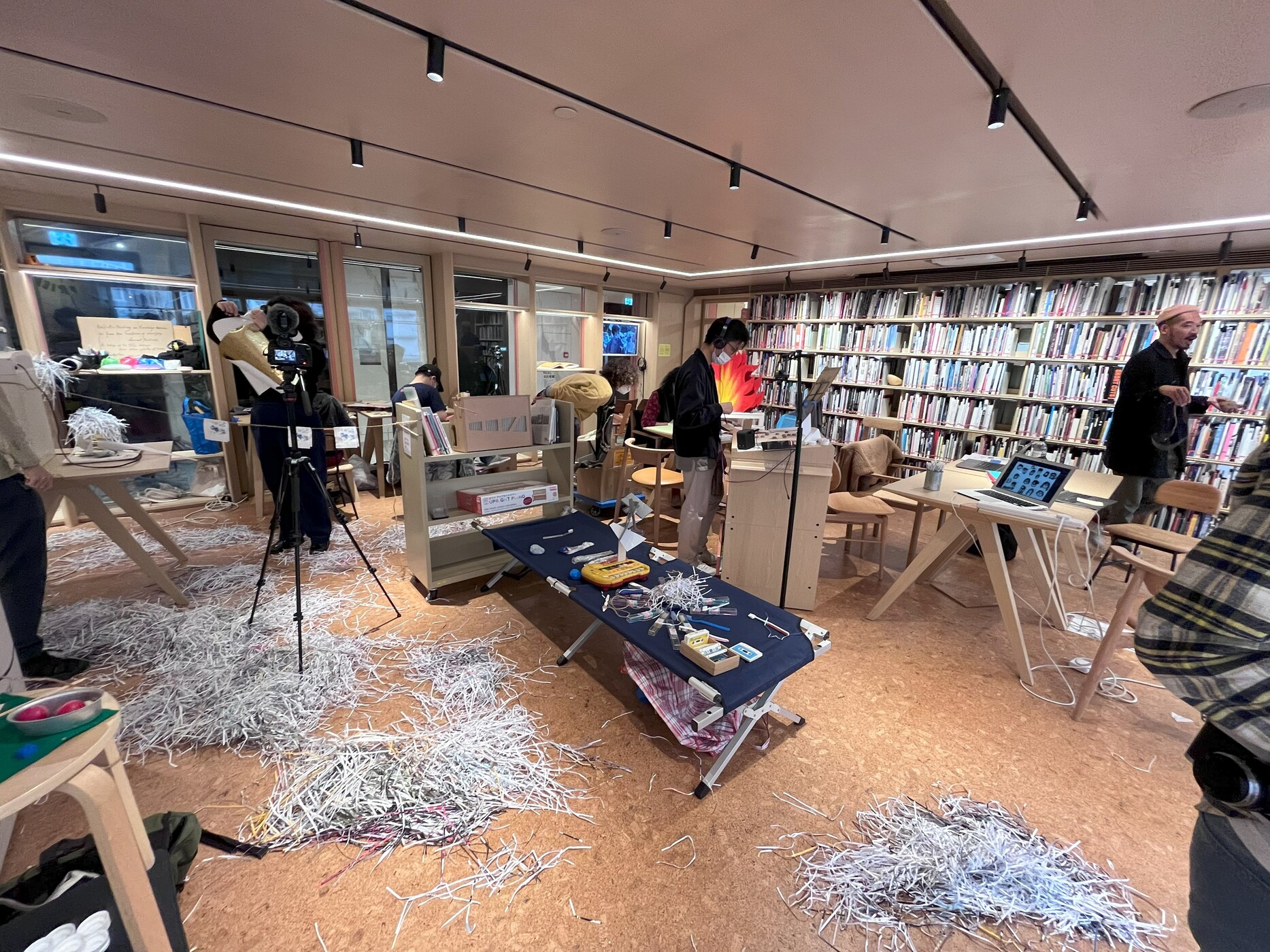
Twenty Alpha, founded in 2013 by Wendy Lee and Dennis Wong (Co-founder of Re-Records, also known as Sin:Ned), and later joined by Steve Hui, exemplifies an independent performance platform oriented towards experimental music, noise, free improvisation, and DIY instruments. Its programming also intersects with sound art and community education. Its City of Sounds education programme (2016) engaged secondary school students in collecting community sounds, culminating in the exhibition City of Sounds: Review 123 Days at Floating Projects.29 In 2018, Twenty Alpha established a residency at the Foo Tak Building in Wan Chai, inaugurating the site with Beta Night (March 2018)—a programme of performances and audio-visual installation.30 In 2023, Twenty Alpha extended its experimental ethos with EYEWITNESSES, a box set of 433 paper cards—evoking John Cage’s conceptual legacy in 4’33’’—each printed with a word describing sound (from “scratchy” to “euphoric”) that serves as an open prompt for performers.31
Institutional Engagement
In the last decade, sound-based work has also gained increasing visibility within major public institutions. Following I/O Flows (2006), the Hong Kong Museum of Art curated Listen to Hong Kong (2016) at the Hong Kong Heritage Discovery Centre, presenting works by Cédric Maridet, Ellen Pau, and Samson Young.32
Tai Kwun has hosted ongoing programmes, including the Sound Forms festival and the performance One ear to hear (2019), curated by Dayang Yraola. Its 2023 exhibition, Sounds Like Print, curated by Ingrid Pui Yee Chu and Edward Sanderson, explored the interplay between sound and print media.33
M+ has similarly foregrounded sound in exhibitions such as Samson Young’s Songs for Disaster Relief World Tour (2018) [MONS.YOS5], curated by Ying Kwok; GayBird’s 18 Ways to Create or Mute Sound (2021), a site-specific performance that activated the museum’s architecture; and, at the time of writing, forthcoming presentations such as Ryuichi Sakamoto | seeing sound, hearing time and Janet Cardiff: The Forty Part Motet.
From non-profit organisations and commercial galleries to artist-run collectives, cultural initiatives, and public museums, this survey demonstrates that however niche sound practices in Hong Kong may appear, they have steadily become part of the city’s art history since the 2000s. What has emerged is a constellation shaped by multiple lineages, diverse institutional contexts, and ongoing intercultural dialogue.
By identifying key organisations, practitioners, and events, this overview offers points of departure for further research on sound practices in Hong Kong.34 It does not privilege sound over other forms, but situates it alongside tactile, multisensory, and interdisciplinary practices, extending critical attention beyond the visual. As Salomé Voegelin reminds us, “Sound does not hold a superior ethical position or reveal a promised land. But it will show us the world in its invisibility…A sonic sensibility reveals the invisible mobility below the surface of a visual world and challenges its certain position, not to show a better place but to reveal what this world is made of, to question its singular actuality and to hear other possibilities that are probable too.”35
Further Reading on Sound Practices in Hong Kong
Yeung Yang, “(Is there such a thing as) Sound Art and Its Development in Hong Kong? A Research Proposal,” in Hong Kong Visual Arts Yearbook 2009, ed. Kurt Chan Yuk-keung (Department of Fine Arts, CUHK, 2010): 114–128 [REF.CYK (Hong Kong Room)].
Edwin Lo, “香港:聲音實踐的現況 (The Present State of Sound Practices in Hong Kong),” in West Bund 2013: A Biennial of Architecture and Contemporary Art, Volume II: Contemporary Art: 244–247 [EX.CHN.WBB.2013].
Dayang Yraola, “Conditions of Enablement of Sound Practices in Hong Kong and Manila” (PhD diss., Lingnan University, 2019).
Damien Charrieras and François Mouillot, eds., Fractured Scenes: Underground Music-Making in Hong Kong and East Asia (Palgrave Macmillan, 2021).
Ryo Ikeshiro, Damien Charrieras, and PerMagnus Lindborg, “Charting the Scene(s) of Sonic Arts in Hong Kong,” Organised Sound 27, no. 3 (2022): 369–378, https://doi.org/10.1017/S1355771822000450.
“Hong Kong,” in The African and Asian alternative database - experimental, sound art, noise and alternative electronic music from underrated continents, Syrphe, accessed 28 October 2025.
* * *
Collection Highlights
The following annotations highlight a range of AAA’s sound collections. Using Hong Kong as a departure point to connect to discourses, exhibitions, and practices in other regions, they convey the diversity of the archive’s holdings. Readers may also search AAA Collections using the keyword “sound art” to explore related materials.
Reference
Brandon Labelle, Background Noise, Second Edition: Perspectives on Sound Art (Bloomsbury Academic, 2015). [REF.LAB]
A foundational study of sound art, Background Noise traces the development of the field since the 1950s, foregrounding sound’s spatial dynamics and its intersections with site-specific and contextual practices. From progenitors of sound art—John Cage, musique concrète, and Group Ongaku—to later developments in conceptual art, performance art, sound installations, soundscapes, and networked performances, the book offers a sophisticated theoretical framework for understanding sound’s role in contemporary spatial and social experience.
Qiu Zhijie, 重要的是現場 (The Scene Is Most Important) (Renmin University of China Press, 2003). (Simplified Chinese) [REF.QZJ]
Before sound art theories circulated in mainland China, exhibitions such as Sound (2000, curated by Li Zhenhua) and Sound 2 (2001, curated by Li Zhenhua and Qiu Zhijie) had already explored the role of sound within exhibition and live performance formats. Participating artists of the exhibitions included members of the Post-Sense Sensibility group, a movement that emerged in the 1990s as a reaction against conceptual art and emphasised live, embodied experience. These early experiments are examined in Qiu’s anthology through “中國發音 (Chinese Sounding),” which reflects on Sound and Sound 2 in relation to the local context. The volume also includes “甚麼是聲音藝術? (What Is Sound Art?),” which traces twentieth-century Western sound art.
Anthology of Essays on Deep Listening, ed. Monique Buzzarté and Tom Bickley (Deep Listening Publications, 2012). [REF.BUM4]
Composer Pauline Oliveros placed the act of listening at the centre of her practice. Beginning with Sonic Meditations in the 1970s, she developed what she called “Deep Listening,” which is “listening in every possible way to everything possible to hear no matter what you are doing.” This anthology brings together essays by composers, sound artists, and educators who engage in Deep Listening from conceptual, somatic, ecological, pedagogical, and spiritual perspectives. From the subterranean waters beneath the Roman Forum and the birdsong of warblers to the biological activity of plants and “listening with the feet” while walking, this volume maps an interdisciplinary landscape of listening practices.
Pocket 2: say, Listen, ed. Yeung Yang (soundpocket, 2013). [REF.YAY8]
Pocket 1: Around [REF.YAY8], published by soundpocket, grew out of the inaugural Around sound art festival, assembling artists to reflect on their listening experience. Pocket 2: say, Listen extends this project by gathering fiction and non-fiction by critical listeners, including accounts of meditation retreats, overseas travel, and encounters with everyday soundscapes—from the classical music heard in a Sham Shui Po public toilet to the sounds of Mong Kok’s Flower Market. The volume also includes Steve Hui’s “433 Words on Sound,” a precursor to Twenty Alpha’s EYEWITNESSES. For readers browsing AAA’s library and tempted to wander nearby, Akio Suzuki’s illustrated oto-date notes offer a cue to listen more closely: in 2010, he marked several spots across Hong Kong with circular signs bearing ears and footprints, inviting passersby to pause and listen. The locations he identified in Sheung Wan can still be explored today.

Artist Monograph
Unintentional Pause—Tsang Sin-yu Solo Exhibition, ed. Susi Law and So Wai-lam (soundpocket, 2017). [MONS.TSY2]
In 2017, soundpocket presented Tsang Sin-yu’s solo exhibition at Empty Gallery, curated by Susi Law. Published on the occasion, this booklet introduces Tsang’s practice. A graduate of the School of Creative Media, Tsang took Samson Young’s sound art course and participated in CMHK’s Sonic Anchor in 2014. The cover image—a pair of mud-stained water boots set by the roadside—quietly foreshadows the motif of water that runs through its first pages. In the exhibition, Tsang assembled and remixed sounds drawn from her home and the city, shaping overlooked details into a sonic environment that invites pause. The booklet records fragmentary notes on sites such as Pei Ho Street Market and Tsz Wan Court, as well as on ordinary materials such as pipes, cement, and retaining walls. Like the exhibition, the publication invites a slower gaze, revealing imaginative potential within the textures and infrastructures of the everyday.
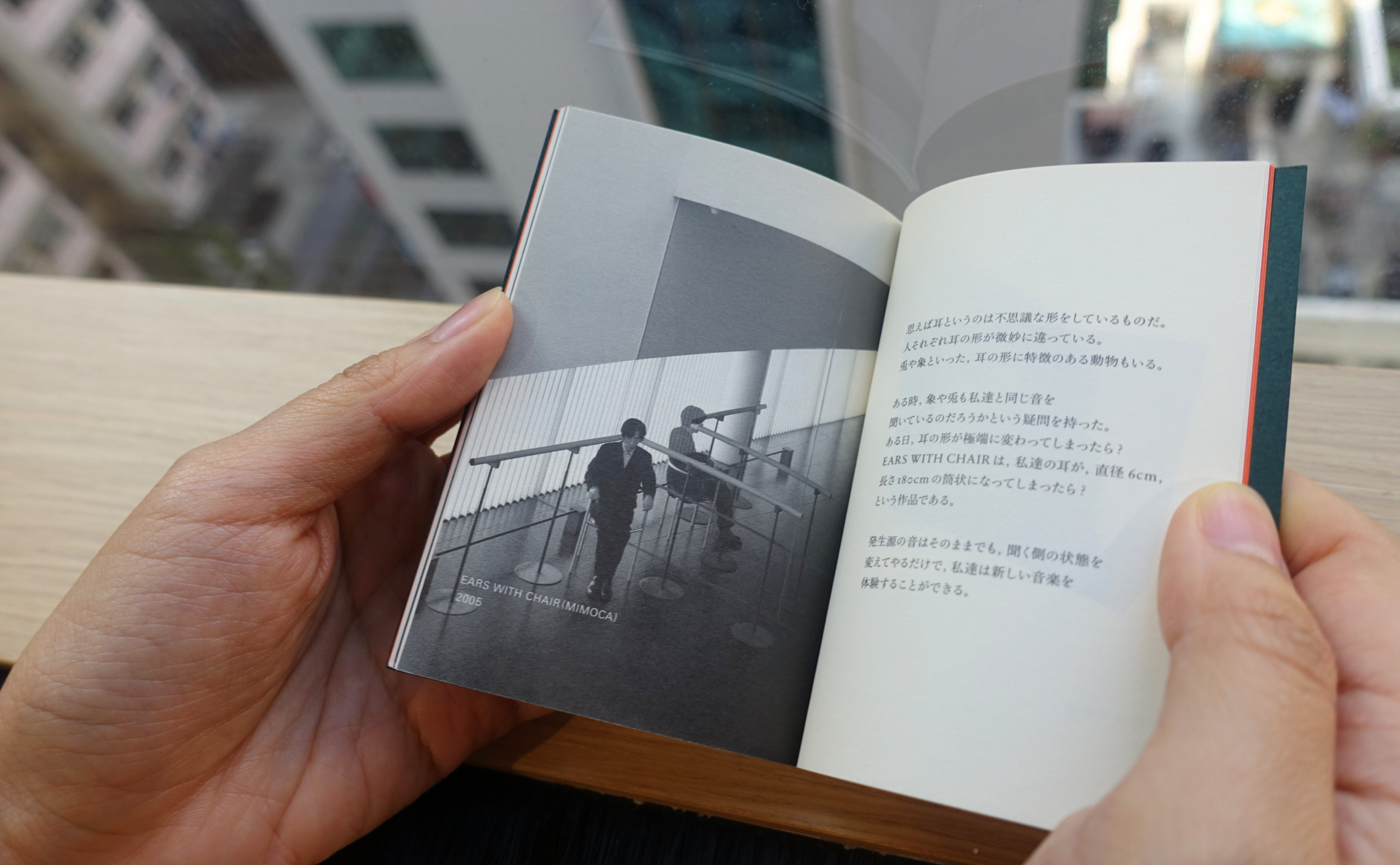
ÉCHO. Son virtuel, ed. Yukio Fujimoto and Takeshi Matsuoka (Hiroshima City Museum of Contemporary Art, 2007). (Japanese) [MONS.FUY]
The publication accompanying Yukio Fujimoto’s solo exhibition is neatly designed. Smaller than a bunkobon, Japan’s pocket-sized paperback format, it fits in the palm like a toy, inviting an intimate encounter. Since the mid-1980s, Fujimoto has worked with sound, employing materials such as music boxes, sugar cubes, and fallen leaves. This booklet gathers the artist’s reflections on works shaped by quiet, everyday poetics. Writing about his work Broom, Fujimoto recalls stepping on dry leaves on a late autumn morning—an experience that inspired him to cover the quiet exhibition space with fallen leaves, allowing visitors’ footsteps to interact with their sounds. In Ears with Chair, he imagines what we might hear if our ears were cylindrical forms six centimetres in diameter and one-hundred-eighty centimetres in length. By transforming ordinary sounds into occasions for attentive listening, these works reveal how imagination can reshape perception.
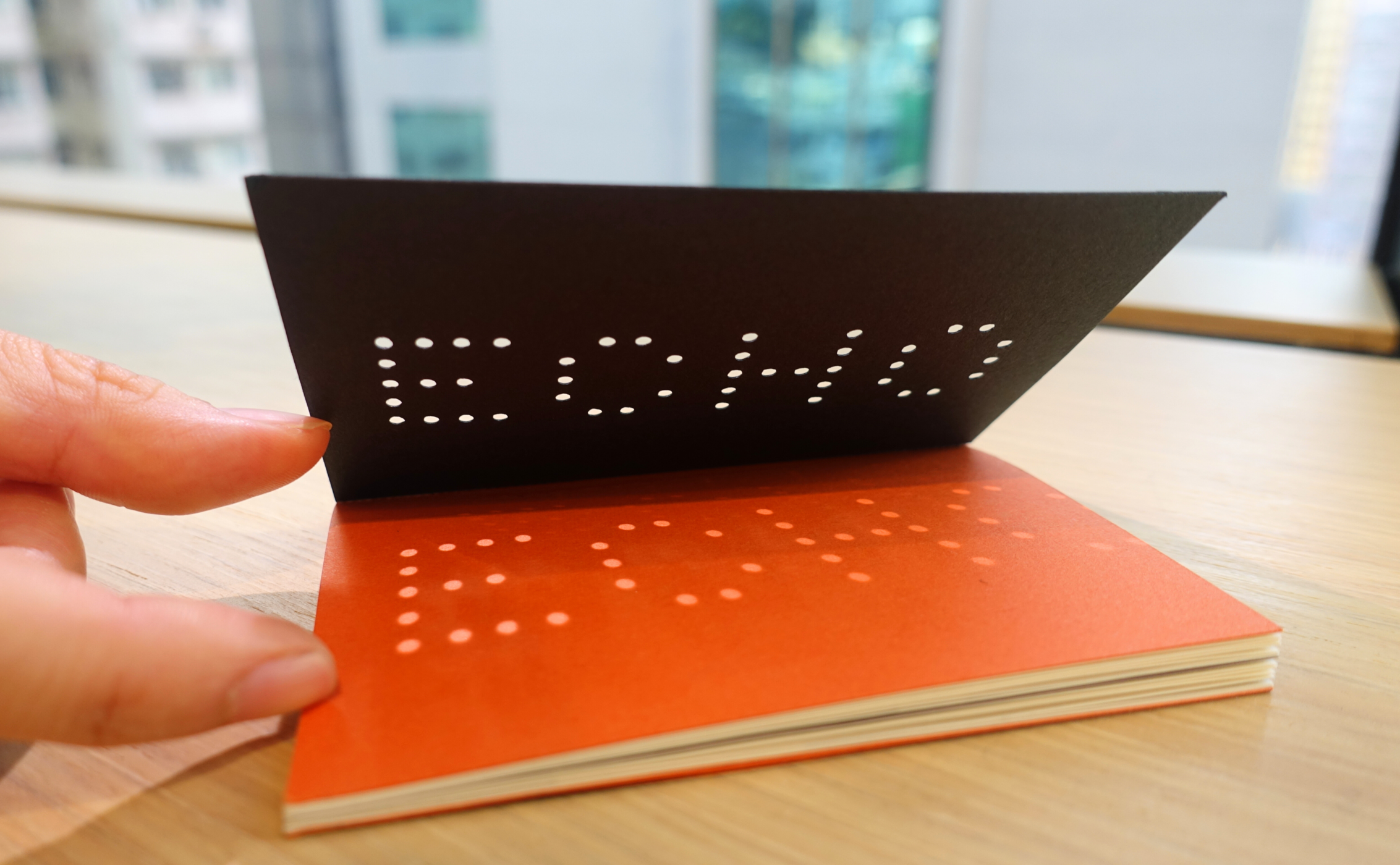
So Lai Ping and Hsu Wai Lun, dok dat dap dap (soundpocket, 2021). [MONS.MMS3]
This artist’s book by So Lai Ping and Hsu Wai Lun is an experimental project that reconstructs twenty-three recordings of rain through a mixed sensory vocabulary of visual signs, onomatopoeia, and tactile design. The selected sound clips are drawn from seventeen films, ranging from My Neighbor Totoro and Fight Club to In the Mood for Love. Conceived as an accessible publication, the project addresses three readerships: the visually impaired, the hearing impaired, and those who engage the world through diverse sensory capacities. Through reading and touching, audiences are invited to reflect on how different communities see or listen to their environments.
Exhibition Catalogue
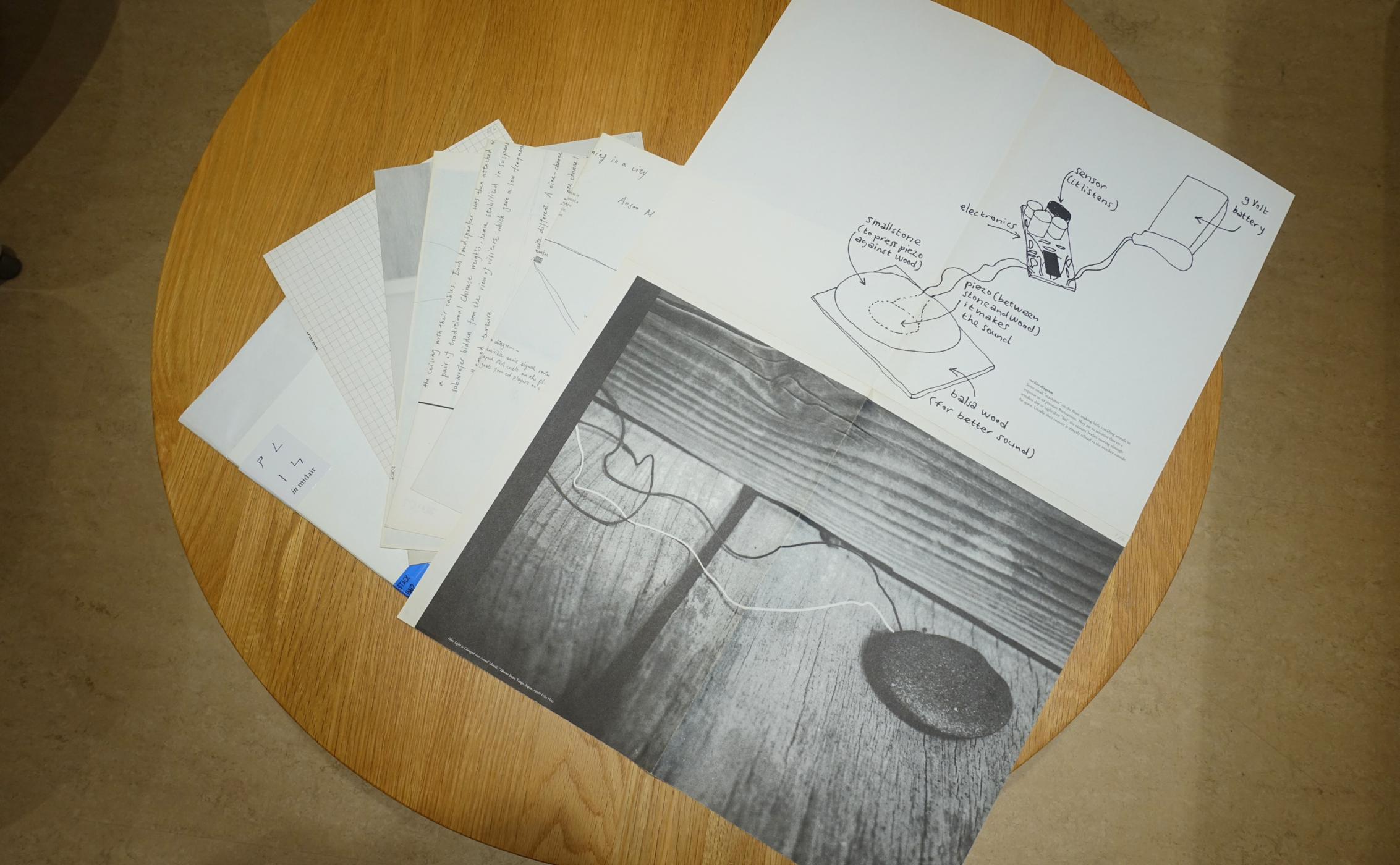
in midair: sound works hong kong 2007, ed. Yeung Yang (2007). [EX.HGK.INM2]
In many respects, in midair, Yeung Yang’s first curatorial exhibition, was distinctive. Both the exhibition and its catalogue revealed a meticulous sensibility. Affixed to the back cover is a paper pocket containing six folded posters. As each poster is withdrawn and unfolded, the reader encounters images of the exhibited works, artists’ statements, installation sketches, and Yeung’s notes. This deliberately inconvenient design—akin to the ritual of playing a vinyl record—imbues the experience with a heightened sense of ceremony, lending the works additional gravitas. By connecting local practitioners with international artists such as Felix Hess and Su-Mei Tse, and by presenting works across multiple venues, the exhibition suggested listening as a method for forming a dialogic sonic network.
Sound Meridians: Cultural Counter-mapping through Sound: Taiwan, the Philippines, Singapore and Malaysia, ed. Amy Cheng, Jeph Lo, and Yujie Huang (TheCube Project Space, 2021). [EX.TAI.TFM]
TheCube Project Space has maintained a sustained commitment to sound studies. Its 2015 publication, ALTERing NATIVism: Sound Cultures in Post-War Taiwan [REF.CHH8], offered a comprehensive historical mapping of Taiwan’s postwar sound cultures. Sound Meridians, the second chapter of The Trilogy of Future Memories, extends this trajectory. The project brings together four curators from across Asia—Jeph Lo, Daying Yraola, Chee-Wai Yuen, and Sow-Yee Au—each working from the sound cultures of their respective contexts. For example, the Taiwan section traces the evolution of the “sound apparatus” in its local context, encompassing technological devices as well as the institutions and regulations that shape listening experience. The Philippines section foregrounds the ecology of its sound community, highlighting artists and artist-run spaces that resonate across disciplines and generations. Collectively, the project demonstrates how sound cultures emerge from specific historical conditions yet circulate beyond geographical boundaries.
x_sound: John Cage, Nam June Paik and After, ed. Sohyun Ahn, Sooyoung Lee, and Chaeyoung Lee (Nam June Paik Art Center, 2012). [EX.KOR.XSJ]
In 1958, John Cage and Nam June Paik first met at Darmstadt International Summer School Course for New Music. Despite a twenty-year age difference, they maintained a close friendship over subsequent decades. In a memorial essay written after Cage’s death, Paik described 1957 as “B.C. (Before Cage),” underscoring the profound impact of Cage’s thought on his own trajectory. The exhibition x_sound: John Cage, Nam June Paik and After traces the arc of their exchange and considers the divergences in their artistic philosophies. Its catalogue assembles historical documents—including letters, scores, and photographs—that chart Paik’s shift from contemporary music toward a conception of “a-music.” Through their explorations of sound, Cage and Paik established a conceptual ground for what would later be recognised as sound art. The exhibition’s second half presents sound installations and video works by contemporary artists—including Kichul Kim, Susan Philipsz, Otomo Yoshihide, and Zimoun—who extend this legacy within new contexts and sensibilities.
Elif Öner and Evrim Kavcar, A Dictionary of Sensitive Sounds (Espas Art Theory Publications, 2021). [EX.TUR.DOS]
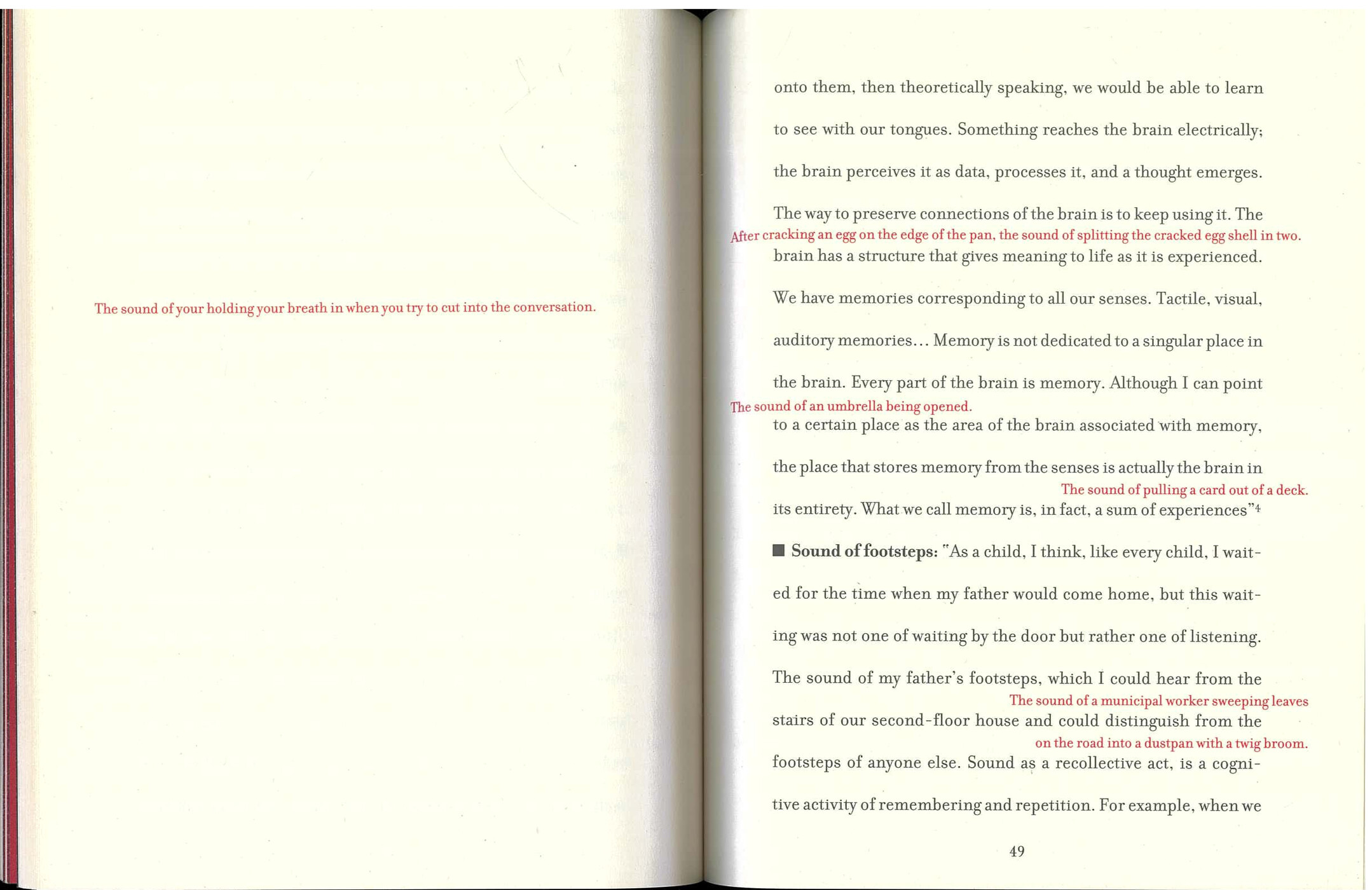
A Dictionary of Sensitive Sounds is an artist’s book shaped by a clear and inventive editorial concept. It emerged from a participatory art project by Elif Öner and Evrim Kavcar comprising two exhibitions, a series of public talks, and workshops. The project explored forms of sound and silence, as well as experiences that elude linguistic articulation. The publication might be more accurately described as an anti-dictionary: rather than offering objective definitions, it assembles entries through interweaving multiple perspectives, anecdotes, and sonic descriptions. Drawing on contributions from twenty speakers across diverse disciplines, and interspersed with descriptions of “sensitive sounds” by artists and workshop participants, the volume forms a polyphonic textual constellation. Approaching sound through psychological, psychoanalytic, scientific, historical, cultural, and social lenses, it attunes readers to faint or overlooked sonic experiences and phenomena. In a time marked by turbulence and crisis, its reflections on listening and silence feel especially resonant.
Periodical
P_PAL, Issue 2 (2023). [PER.PAL]
P_PAL is a magazine dedicated to documenting China’s self-publishing scene and bookmaking practices. Issue 2 broadens its scope to community-driven initiatives, including a feature on community radios. The article traces the medium’s lineage from pirate radio and includes interviews with Hong Kong Community Radio (HKCR), Shanghai Community Radio (SHCR), Chengdu Community Radio (CDCR), and the independent platform BAIHUI. Reflecting on the role of community radios, HKCR founder Gavin Wong emphasises the importance of building robust networks rooted in an egalitarian, bottom-up model. HKCR’s programming reflects this ethos through collaborations with experimental musicians and field recording projects, including Steve Hui (Nerve), AK IN KK, and Tzu Ni.
White Fungus, Issues 13, 14, 16. [PER.WHF]
White Fungus is an arts magazine founded in 2004 by Ron and Mark Hanson in Wellington, New Zealand, and is now based in Taichung, Taiwan. While covering contemporary art, history, and politics, the publication has maintained a sustained engagement with sound art. Issue 14 features an interview with Wang Fujui and an article by Yan Jun recalling a performance in which Huang Dawang peeled garlic among the audience. The issue debuted at a sound event at SOUP in Tokyo, with performances by KK Null, Noise Steve, Betty Apple, and Kaya Hanasaki. See also issues 13 and 16, which include an essay on Hong-Kai Wang and a historical account of Taiwanese noise music in the post-martial law era, respectively.
典藏.今藝術 (ARTCO), nos. 174 (March 2007) and 222 (March 2011). (Traditional Chinese) [PER.ARD]
As one of Taiwan’s long-standing monthly magazines dedicated to contemporary art, ARTCO has organised special features on the development of sound art in Taiwan, which remain important references. In Issue 222, Amy Cheng and Jeph Lo examine the politics of sound and its interplay with broader sociocultural contexts in Taiwan. Wu Muqing surveys the landscape of sound practices in Taiwan through three domains: exhibitions, academic institutions, and non-academic initiatives. The feature concludes with Wu’s diagram mapping eight major lineages that have shaped contemporary sound practices, including noise, aleatory music, musique concrète, free jazz, and computer music.
Zine
EE01–03 Reported, ed. Exit-Entry (2024). [ZIN.EXE]
Titled after the Exit-Entry Permit used by mainland Chinese residents travelling to Hong Kong and Macau, Exit-Entry is a live performance series co-curated by Edward Sanderson and Suze Chan, with Brian Chu joining the team from the fourth edition onward. The inaugural event took place at Twenty Alpha in 2023, featuring performances by Lin Zhiying from Shenzhen and Zhou Pei from Guilin, alongside Hong Kong artists klaux and mo. The programme also included a short film screening by Winsome Wong. EE01–03 Reported documents the first three iterations of the series. Bringing together reflections and inner monologues from participating artists on their performances, the self-published zine extends the dialogue between artists and audiences beyond the live events.
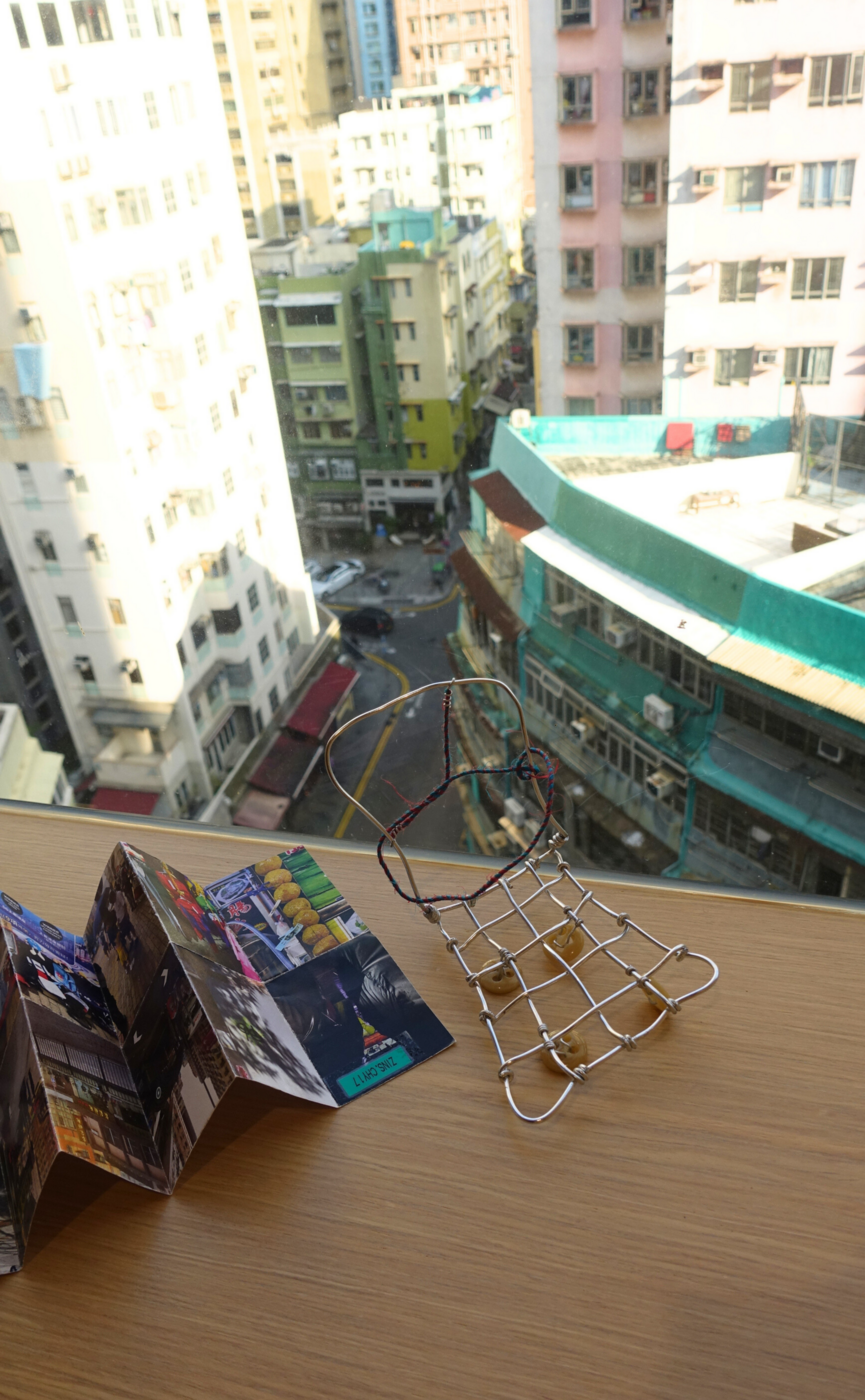
Chung Wong, Soundscapes around Sham Shui Po (2025). [ZINS.CHY17]
This zine is instantly memorable in its form. The booklet wraps around a small, playful miniature handcart—an affectionate homage to this everyday tool of labour. Opening the booklet reveals street scenes from Sham Shui Po. By scanning the codes in the zine, readers can listen to three soundscape recordings from the neighbourhood. In “Pulling the Cart—From Tai Po Road along Kweilin Street to Cheung Sha Wan to Buy Groceries,” the metallic rattle of a handcart takes centre stage, interwoven with traffic noise and fragments of conversation, drawing attention to the rhythms of routine labour. “Birdsong from the Big Tree by Pei Ho Street Tunnel” captures bright calls that momentarily lift the spirit amid the dense urban noise. “Fabric Market—On the Eve of the Relocation of the Hawker Bazaar on Yen Chow Street” records the quiet soundscape of “Pang Jai,” an organically formed grassroots textile market, just before its relocation. Here, the handmade, self-published zine becomes an apt medium for documenting the self-sustaining, vernacular textures of community life.
CD
Background (of Chinese Sound Art) (Kwanyin Records, 2009). [CD.001427]
This CD was released with Avant Garde Today, Issue 15 [PER.AGT]. It was originally intended to accompany Yan Jun’s essay “Background: Sound Art in China,” published in Issue 14. The tracks, gathered in 2006, document early experiments by a range of artists at a moment when what came to be described as “sound art” was just beginning to emerge in China. The opening and closing tracks are recorded directly from the Buddha Machine created by the duo FM3. The device integrates hypnotic, meditative looped sound pieces into an object modelled on the small electronic device used by Buddhists for prayer. Li Jianhong’s “Metal Pussy, Metal Noise” (track 3) is a work of noise music. Its dense field of high-frequency noise resembles a disrupted signal, producing an abrasive, almost shattering sensory intensity. Wang Fan’s “In deep silence” (track 5) was created using a digital multitrack recorder. Through the repetition of pulsing rhythmic patterns, the piece searches for a state of inward concentration. “Net Soundscape” (track 10) by 8GG draws on recordings the artist made in 2001 while working at an internet company, using recording software to capture the sounds encountered online during daily browsing. Edited from this material, “Net Soundscape” distils the sensibility of the virtual world at the turn of the millennium.
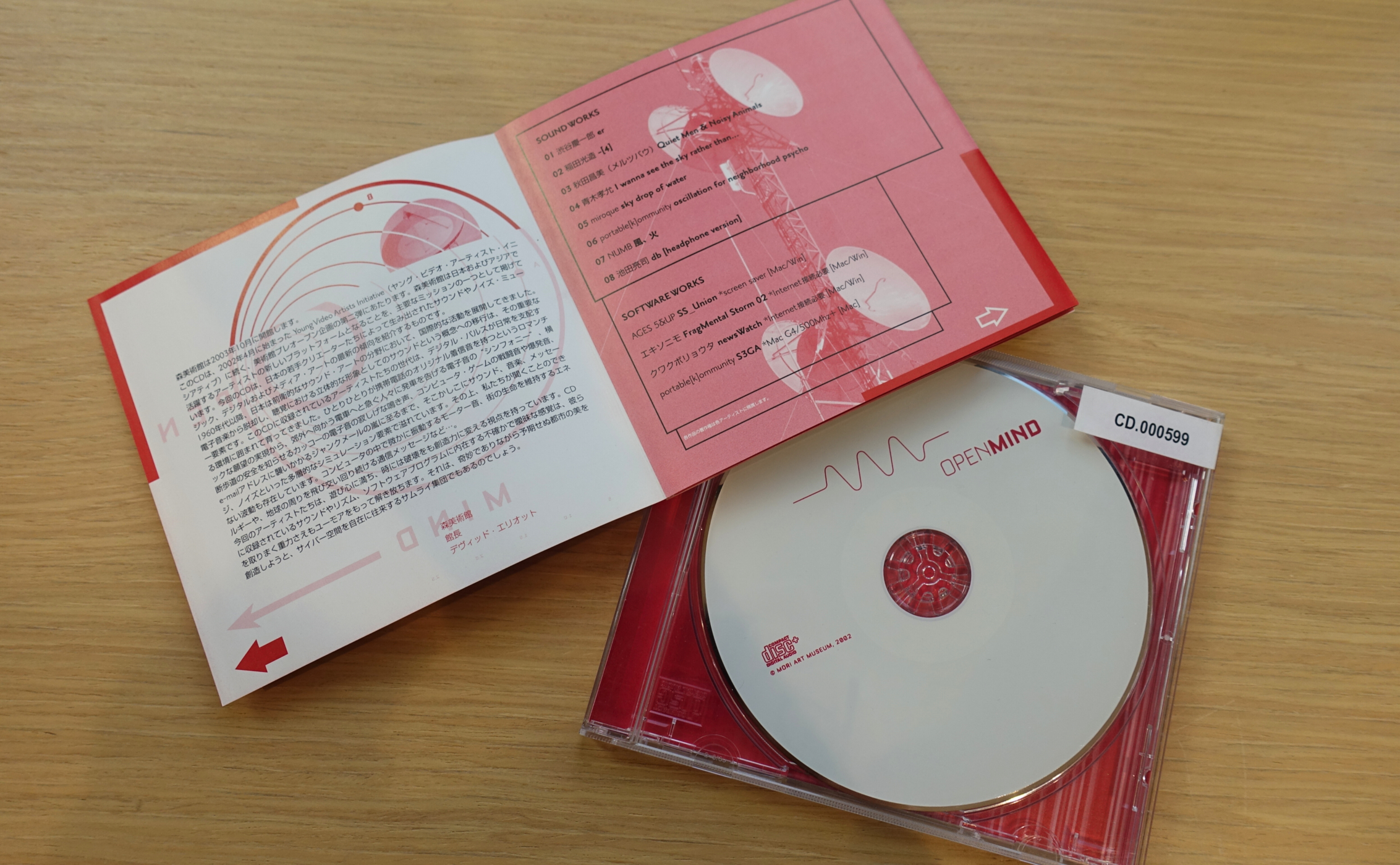
[OPENMIND] (Mori Art Museum, 2002). [CD.000599]
This CD was produced as one of the pre-opening projects for the Mori Art Museum in 2003. The compilation presents a selection of recent Japanese sound, noise, and media art, including several works commissioned by the museum. The opening track, “er,” by Keiichiro Shibuya, is constructed from computer crash sounds, test tones ranging from 45 Hz to 15,000 Hz (the approximate range of human hearing is 20–20,000 Hz), and the noise-like errors generated when these elements were combined. From these materials, the piece assembles an alternative digital structure built from malfunction and error. “Quiet Men & Noisy Animals” (track 3) by Masami Akita (Merzbow) explores biological diversity beyond the boundaries of human order through dense electronic noise, evoking a spectrum of life forms ranging from subterranean bacteria to large mammals. “db [headphone version]” (track 6) by Ryoji Ikeda originated as a sound installation. The CD version is a stereo remix derived from the original six-channel sound source created for an anechoic chamber. Using sine waves, white noise, and other elements, the work deliberately blurs the boundary between noise and music. As David Elliott, then Director of the Mori Art Museum, remarked, the disc’s subtle textures of sound and rhythm “set themselves against, and even make fun of, centralised control,” opening space for unforeseen forms of beauty.
Other Recommended Readings
Sound, ed. Caleb Kelly (The MIT Press and Whitechapel Gallery, 2011). [REF.WHC]
Audio Culture: Readings in Modern Music, ed. Christoph Cox and Daniel Warner (Bloomsbury Academic, 2017). [REF.WAD4]
Joanna Demers, Listening through the Noise: The Aesthetics of Experimental Electronic Music (Oxford University Press, 2010). [REF.DEJ6]
Salomé Voegelin, Listening to Noise and Silence: Towards a Philosophy of Sound Art (Bloomsbury, 2010). [REF.VOS3]
The Listening Biennial Reader, vol. 1: Waves of Listening, ed. Brandon Labelle (Errant Bodies Press, 2023). [REF.LAB]
Jing Wang, Half Sound, Half Philosophy: Aesthetics, Politics, and History of China’s Sound Art (Bloomsbury Academic, 2021). [REF.WAJ]
Lin Chi-Wei, 超越聲音藝術:前衛主義、聲音機器、聽覺現代性 (Beyond Sound Art: The Avant Garde, Sound Machines, and the Modernity of Hearing) (Artist Publishing, 2012). (Traditional Chinese) [REF.LCW6]
substantials #02, ed. Akiko Miyake (CCA Kitakyushu, 2005) [REF.CCA2]
West Bund 2013: A Biennial of Architecture and Contemporary Art, Volume II: Contemporary Art (Tongji University Press, 2013). [EX.CHN.WBB.2013]
Open Museum Open City, ed. Hou Hanru (Mousse Publishing, 2014). [EX.ITA.OMO]
It Always Sounds Somewhere: Sounding Sound Practice in Chinese Mainland and Hong Kong Since the 1990s (Inside-Out Art Museum, 2025). [EX.CHN.IAS]
Scenes in a Box, ed. Shih Ya Tien (Notation Room, 2025). [EX.TAI.SIB]
Jaren Ng is Associate Editor at Asia Art Archive.
Notes
1. This shortlist is drawn from the author’s encounter with In Our Own Backyard in Asia Art Archive’s library. By the window, a screen printing manual by Lala Rukh was displayed alongside other materials. From a speaker overhead came Subh-e-Umeed, the artist’s only sound work—a ten-minute loop combining birdsong recorded on morning walks, chants from the Pakistan Lawyers’ Movement, and a Hindustani classical raga. These layers illustrate sound’s environmental, political, and cultural registers, creating a continuous soundscape that extends attention beyond the visible. Subh-e-Umeed is available online in “In Memoriam: Lala Rukh (1948–2017),” by Natasha Ginwala, documenta 14, accessed 13 October 2025. See also the interview with Sarah Zaman—the vocalist who collaborated with Lala Rukh on this work—conducted by Mariah Lookman and published in Mousse Magazine.
2. Alan Licht, “Sound Art: Origins, development and ambiguities,” Organised Sound 14, no. 1 (2009): 3, https://doi.org/10.1017/S1355771809000028.
3. Mark Peter Wright, through his platform Ear Room, asked various artists and writers, “What does the term ‘sound art’ mean to you?” Their responses are compiled here, accessed 13 October 2025.
In Hong Kong, soundpocket undertook a similar inquiry, conducting research interviews with local artists—including Phoebe Hui, Steve Hui (Nerve), Anson Mak, Cédric Maridet, Kingsley Ng, Samson Young, among others—on what “sound art” means to them. Excerpts from these interviews are available here and here, accessed 13 October 2025 (also available in Chinese).
4. Bernhard Gál traces the earliest uses of the term “sound art,” noting its appearance in the 1979 Sound Art exhibition curated by Barbara London at the Museum of Modern Art, as well as on the cover of Something Else Yearbook 1974, edited by Jan Herman. See Bernhard Gál, “Updating the History of Sound Art: Additions, Clarifications, More Questions,” Leonardo Music Journal 27 (2017): 78–79, https://doi.org/10.1162/LMJ_a_01023.
For a broader account of the development of sound-themed exhibitions, including multisensory works, see Seth Cluett, “Ephemeral, Immersive, Invasive: Sound as Curatorial Theme, 1966–2013,” in The Multisensory Museum, Cross-Disciplinary Perspectives on Touch, Sound, Smell, Memory, and Space, ed. Nina Levent and Alvaro Pascual-Leone (Rowman & Littlefield, 2014).
5. “Sound art,” Tate, accessed 13 October 2025.
6. The Museum of Modern Art, press release no. 42 for Sound Art exhibition, 25 June–5 August 1979.
7. Museum of Portable Sound, “How’s this for a working definition of ‘Sound Art’?,” Facebook, 23 December 2018, accessed 13 October 2025.
8. Translation from original Chinese text. Yan Jun, “背景:聲音藝術在中國 (Background: Sound Art in China),” in Avant Garde Today, no. 14 (2007): 189. [PER.AGT]
9. Yan Jun, “怎樣被世界改變──現實中的中國聲音實踐 (How to be Changed by the World: China’s Sound Practices in Reality),” in West Bund 2013: A Biennial of Architecture and Contemporary Art, Volume II: Contemporary Art (Tongji University Press, 2013): 220–232. [EX.CHN.WBB.2013]
10. For the background and setup of the performance, see Cédric Maridet, “Noises That No One Else Hears,” in Fractured Scenes: Underground Music-Making in Hong Kong and East Asia (Palgrave Macmillan, 2021): 121–132.
11. “SAND” stands for sound, art, noise, and drone. The festival featured field recording compositions, electronic practices, jazz, and sound–image works, and aimed to broaden public understanding of experimental music. See Crystal Tai, “Sound blaster,” South China Morning Post, 22 June 2006.
12. The artists included Vito Acconci, John Levack Drever, Phoebe Hui, Steve Hui, Keith Lam, Leung Chi Wo, Edwin Lo, Anson Mak, Cédric Maridet, Kingsley Ng, and Kurt Schwitters.
13. The artists included Felix Hess, Anson Mak, Cédric Maridet, Kawai Shiu, Su-Mei Tse, Yeung Ngor-wah, Yuen Cheuk-Wa, and Robert Iolini.
14. For background of in midair and the establishment of soundpocket, see “Research on the Development of Sound Art in Asian Countries: Interview with Ms. Yeung, Yang,” conducted by Katsushi Nakagawa and Tomotaro Kaneko, Tokiwadai Journal of Human Sciences 2, no. 1 (2016): 80–91.
15. “About Us: Our Vision,” soundpocket, accessed 28 October 2025.
16. In 2021, soundpocket hosted the 10 Years of ASP, bringing together artists who had received awards from its Artist Support Programme over the last decade. soundpocket also conducted interviews with sixteen alumni from the programme; excerpts are available here, accessed 28 October 2025 (also available in Chinese).
17. For example, see Samson Young’s performance and artist talk on the Lacking Sound Festival YouTube Channel, and Fang Yen Hsiang’s essay on Young’s performance on the festival’s website (also available in Chinese), accessed 28 October 2025.
18. François Mouillot and Damien Charrieras, “Interview with Samson Young,” in Fractured Scenes (Palgrave Macmillan, 2021): 109–119.
19. Video documentation of the performance and an artist conversation, along with a short concert review by Tsang Sin-yu, are available on the CMHK website, accessed 28 October 2025.
20. Documentation of the concerts is available on the CMHK website, accessed 28 October 2025.
21. “About,” Contemporary Musiking Hong Kong, accessed 28 October 2025.
22. The two organisations have collaborated on multiple occasions. For example, in 2016 they co-organised Feeding Frenzy: A Culinary Concert, the Asia premiere of a performance originally conceived by New York-based composer Fast Forward.
23. For video documentation and contextual background on Assemblage, see “Video Zine #5: {SeT} #1 Assemblage + Spatial Pressure Calibration,” published on D-Normal/V-Essay, an online platform by Floating Projects, accessed 28 October 2025.
24. Wong Fuk-kuen reflected on the Assemblage events in “The weathers of the assemblage-assemblies,” Floating Projects, 2 July 2022, accessed 28 October 2025.
25. Established in 1998, SCM has offered courses related to sonic arts. Other faculty members who have taught in this area include Takuro Mizuta Lippit (dj sniff, 2012–17), Ken Ueno (2018–19), Ryo Ikeshiro, Damien Charrieras, and PerMagnus Lindborg. Sound-related exhibitions and performances at the Run Run Shaw Creative Media Centre have included White Walls Have Ears (2011), curated by Samson Young; Revolution Per Minute: Sound Art China (2014), curated by Yao Dajuin—a touring exhibition previously presented at Colgate University, New York, and West Bund Architecture and Contemporary Art Biennale 2013, Shanghai; and the lecture and performance series 30 Years Of Sound Art In Hong Kong, Mainland China And The World (2014).
26. The workshop was part of the project intersection in midair. See “SOUND MOVEMENT ~ Object Articulation Workshop with suzueri,” Floating Projects, accessed 28 October 2025.
27. Since 2007, Guilty Pleasures has been presented in Singapore and other cities; see The Book of Guilty Pleasures [MON.ASM3], ed. Song-Ming Ang and Kim Cascone (2011).
28. For details of Spring Workshop’s events, see “Spring Workshop Archive & Resources,” accessed 28 October 2025.
29. Twenty Alpha, “[Exhibition Opening] 「育聲.我城.電樂展」 City of Sounds: Review 123 days,” Facebook, 18 July 2016, accessed 28 October 2025.
30. Twenty Alpha, “β 實驗夜 | Beta Night,” Facebook, 30 March 2018, accessed 28 October 2025.
31. Demonstration videos by the artists are available on Twenty Alpha’s YouTube Channel, accessed 28 October 2025.
32. See also Itchy Ears, the education programme of the exhibition (soundpocket, 2016). [REFS.SOU2]
33. “Sounds Like Print,” Tai Kwun, accessed 28 October 2025. Edward Sanderson also maintains a Sound Archive in To Kwa Wan devoted to sound-related materials from mainland China and Hong Kong.
34. For perspectives situating Hong Kong’s sound cultures within a broader context beyond the art scene, see Kung Chi Shing, Peter Suart, Lo Yin Shan, and Valerie Doran, eds., The Box Book: Conversations (MCCM Creations, 2009) [MON.BOX], which compiles conversations by Kung Chi Shing and other cultural figures, tracing Hong Kong’s cultural history from 1987 to 2009. See also Ahkok Wong, Caak3 Seng1 (soundpocket, 2016) [REF.WCK2], which gathers the author’s commentary on local band ecologies, industrial building communities, and government cultural policy.
35. Salomé Voegelin, Sonic Possible Worlds, Revised Edition (Bloomsbury Academic, 2021): 3.
Banner image: Covers of selected materials from this shortlist.